
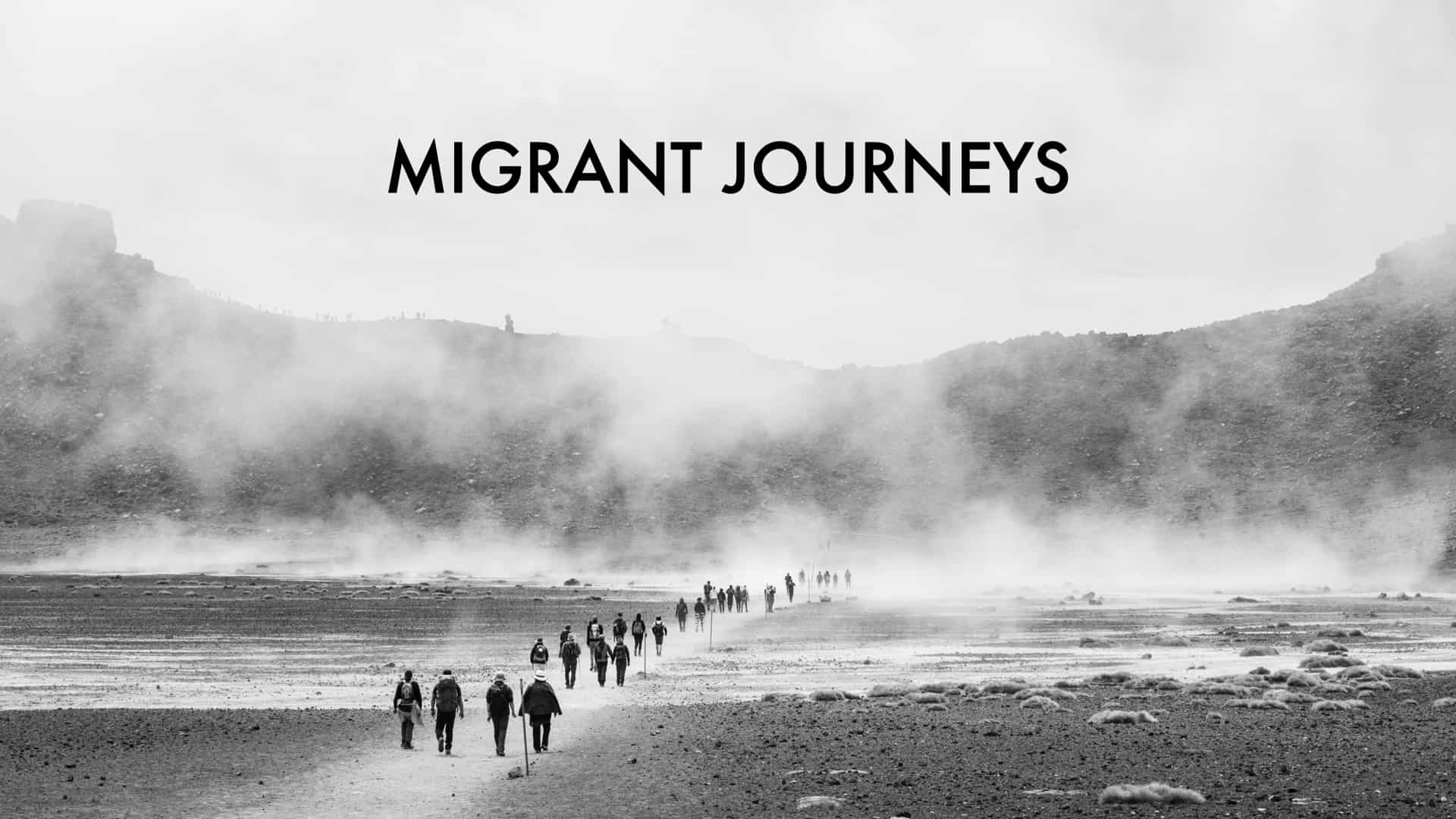
Migrant Journeys: Abraham and Sarah
Genesis 12:1-20
This sermon reads Genesis 12 as a migration story, following Abraham and Sarah from the inside as displaced people rather than as tidy heroes of faith. It traces their uprooting from the safety of clan and homeland, their flight to Egypt driven by famine, and the cost of their vulnerability there, where a frightened Abram hands Sarai over to Pharaoh to save himself. The turn comes in God’s quiet intervention on Sarai’s behalf: even when no human being is advocating for the powerless woman in Pharaoh’s house, God sees her, and that faithfulness does not depend on Abraham getting it right. Reading through the lens of Karen Gonzalez’s The God Who Sees, the message presses the congregation to set down sanitized retellings, recognize God’s persistent attention to the foreigner and the unprotected, and let that same gaze reshape how they see migrants and strangers today.
Sermon Notes
Migrant Journeys: Abraham and Sarah
June 7 · Genesis 12:1-20
Opening: What Do You Take When You Can't Take Everything?
A few years ago a photograph circulated of a family walking a road somewhere in the Middle East. The father carries two small children; the mother, a bag on one shoulder and a third child by the hand. And tied to the top of their bundle, wrapped carefully in plastic, is a framed family photograph. Everything else could maybe be replaced. Not that. That was the thing worth carrying.
It makes you ask: what would you take? If you had to leave tonight, what fits in one bag, and what do you carry because you cannot walk away without it?
That question is not hypothetical for millions of people alive right now. And it turns out it wasn't hypothetical for the very first family in the story of God's people.
For the next several weeks we're going to read Scripture from a different angle: from the road, from the perspective of people who crossed borders and weren't sure they'd survive the leaving. Karen Gonzalez, in The God Who Sees, invites us to do exactly that. Today we start with Abraham and Sarah.
Abraham and Sarah Are Migrants
Here's the verse that launches everything:
1 Now the Lord said to Abram, "Go from your country and your kindred and your father's house to the land that I will show you. 2 I will make of you a great nation, and I will bless you, and make your name great, so that you will be a blessing. 3 I will bless those who bless you, and the one who curses you I will curse; and in you all the families of the earth shall be blessed."
Genesis 12:1-3
That's it. No map. No arrival date. No guarantee of what they'll find. Just go.
We've heard it so often we've stopped feeling its weight, flattened into a metaphor about stepping out in faith, missing what's actually being asked. The Hebrew word translated "kindred" is moledet: your birthplace, yes, but also the whole web of people who define who you are and what you're worth. In the ancient Near East your clan was everything: legal protection, healthcare, social security, and identity all in one. Sick, wronged, or destitute, you survived because your clan caught you.
To leave your moledet was not romantic. It was to become, almost overnight, legally invisible. Relationally unmapped. Socially unprotected. Abram and Sarai don't just lose their home; they lose everyone who would vouch for them. They become what the Bible will call them again and again: strangers. Sojourners. Foreigners.
Not a gap year, not a dream they're chasing. Just two ordinary people at the edge of everything familiar, holding whatever fit in the bag. Strangers in a strange land.
Migration Creates Vulnerability
The journey doesn't get easier once they leave. It gets harder. We get so caught up in the call of verses 1-3 that we breeze past one of the most important lines in the chapter:
4 So Abram went, as the Lord had told him; and Lot went with him. Abram was seventy-five years old when he departed from Haran. 5 Abram took his wife Sarai and his brother's son Lot, and all the possessions that they had gathered, and the persons whom they had acquired in Haran; and they set forth to go to the land of Canaan. When they had come to the land of Canaan, 6 Abram passed through the land to the place at Shechem, to the oak of Moreh. At that time the Canaanites were in the land. 7 Then the Lord appeared to Abram, and said, "To your offspring I will give this land." So he built there an altar to the Lord, who had appeared to him. 8 From there he moved on to the hill country on the east of Bethel, and pitched his tent, with Bethel on the west and Ai on the east; and there he built an altar to the Lord and invoked the name of the Lord. 9 And Abram journeyed on by stages toward the Negeb. 10 Now there was a famine in the land. So Abram went down to Egypt to reside there as an alien, for the famine was severe in the land.
Genesis 12:4-10
Read it slowly. Famine. Severe. And so he went.
This isn't a theological detour, and it's not Abram losing his nerve. It's survival. The land God pointed him toward couldn't feed him, so they did what hungry, displaced people have always done: they moved toward food, toward staying alive.
Scholars sometimes treat this as a test Abram failed. But that sanitizes what famine actually is: children crying, crops failing, the terrible math of how many days until this gets worse. Famine drove the Irish across the Atlantic and Dust Bowl families west; it drives families today across deserts and rivers and borders drawn long after their grandparents were born. People don't leave their home, their language, their moledet because it's easy. They leave because staying has become impossible.
By the time they cross into Egypt they are what the text literally calls them: gerim, resident aliens who arrived without connections, standing, or anyone to vouch for them. And that vulnerability is about to cost them terribly.
God Sees Vulnerable Migrants
Here's where most Sunday school versions go quiet. Abram gets to Egypt, there's a vague "misunderstanding," and we skip to the rescue. But the text won't let us do that.
11 When he was about to enter Egypt, he said to his wife Sarai, "I know well that you are a woman beautiful in appearance; 12 and when the Egyptians see you, they will say, 'This is his wife'; then they will kill me, but they will let you live. 13 Say you are my sister, so that it may go well with me because of you, and that my life may be spared on your account." 14 When Abram entered Egypt the Egyptians saw that the woman was very beautiful. 15When the officials of Pharaoh saw her, they praised her to Pharaoh. And the woman was taken into Pharaoh's house. 16 And for her sake he dealt well with Abram; and he had sheep, oxen, male donkeys, male and female slaves, female donkeys, and camels.
Genesis 12:11-16
Abram is afraid, and his fear isn't irrational. He's a foreign man with no legal standing in a powerful empire, doing the brutal arithmetic every vulnerable person learns when no one will speak for them. But here's what we cannot sanitize: his survival plan puts Sarai at direct risk. He doesn't ask her. He tells her. And she, with even less power than he has, complies. Sarai is taken into Pharaoh's household.
And we cannot leave that sentence as politely as the text does. "Taken into Pharaoh's household" is exactly the kind of phrase that lets us look away. Karen Gonzalez will not. Look back at verse 16: while Sarai is inside that house, Abram prospers. He is paid for her. He grows wealthy, sheep and oxen and servants and camels, off a powerful man's access to his wife's body. Gonzalez calls it by its name: this is human trafficking. Abram commits fraud by passing her off as his sister, he coerces her into a situation she has no way out of, and he profits from her sexual exploitation. Sarai has no voice in any of it. She is doubly displaced: first as a migrant, and then as a woman trafficked inside her own husband's plan to survive. And it is not the last time. In Genesis 20 he does it again, with Abimelech. The father of our faith trafficked his wife, and he did it twice.
Now, some of you are already reaching for the rescue. "But God stopped it. She never actually had to sleep with Pharaoh." I understand why we want that. But that detail is not in Genesis 12. This text never tells us what did or did not happen in that house. We borrow it from Genesis 20, the second time Abraham does this, where God says plainly, "I did not let you touch her." Chapter 12 gives us no such comfort. It just says she was taken, and that Abram got rich. And even if the rescue came in time, look at what "in time" already cost: by verse 16 she had been handed over, priced, made available, living as another man's property while her husband counted his livestock. Trafficking is not only the assault. It is the selling. It is having no voice over your own body. So the real question is not whether God rescued her body in time. It is whether we are willing to see what was already done to her.
This is what vulnerability looks like for the foreign woman, the immigrant woman, across history, and it did not stay in Genesis. Gonzalez points us to Amnesty International's estimate that more than sixty percent of women crossing our southern border are sexually assaulted along the way, and to studies suggesting that as many as eighty percent of trafficking victims are foreign-born women and girls. Sarai carries displacement in her body in ways the men in the story do not, and so do they.
Abram's fear doesn't make him a monster. It makes him human. But the text isn't a model; it's a mirror, and it quietly presses one question on us: who pays the price when the vulnerable are not protected?
And then, right there, in the middle of the worst of it, God moves. Not to congratulate Abram. Not to bless the deception.
17 But the Lord afflicted Pharaoh and his house with great plagues because of Sarai, Abram's wife. 18 So Pharaoh called Abram, and said, "What is this you have done to me? Why did you not tell me that she was your wife? 19 Why did you say, 'She is my sister,' so that I took her for my wife? Now then, here is your wife, take her, and be gone." 20 And Pharaoh gave his men orders concerning him; and they set him on the way, with his wife and all that he had.
Genesis 12:17-20
That little word but is doing enormous work. While Abram has gone silent, while no human being in the story is advocating for Sarai, God is. Pharaoh's house begins to shake, and it shakes because of Sarai. She is not a footnote. She is the one God is paying attention to.
This is the heartbeat of Gonzalez's reading: a God whose gaze falls on the people who've fallen through everyone else's protection. God does not wait for the powerful to do the right thing. God sees the woman in Pharaoh's house. And here is the stubborn, uncomfortable grace of it: God's faithfulness to Sarai does not depend on Abraham's faithfulness to her. The covenant does not pause while Abram fails. Steadfast love is not a reward for good behavior; it is the ground beneath the feet of people stumbling through the dark.
The Landing: Will We See What God Sees?
Abraham and Sarah were migrants: uprooted, displaced, hungry, afraid. They crossed borders they didn't choose and made decisions, some faithful and some desperate. And through all of it, the God who sees never stopped seeing them.
That same God sees every person who has ever packed a life into a single bag and walked into the unknown: every family that has crossed a desert, a river, a checkpoint; every person living without the belonging that makes us feel human. God's gaze does not require documentation.
And here the story stops being about people far away and becomes about us. If God's attention is drawn, again and again, to the stranger and the sojourner and the woman no one will advocate for, then the people who follow this God cannot look away either. We don't get to see immigrants as categories or statistics or talking points. We're asked to see them the way God does: as people. As image-bearers. As someone's family, carrying whatever fit in the bag.
So remember that photograph, the framed picture tied to the top of the bundle, the one thing worth carrying. Somewhere, right now, someone is carrying it. And the question this story leaves us with will follow us out the door: when we see them, will we look away, or will we see what God sees?