
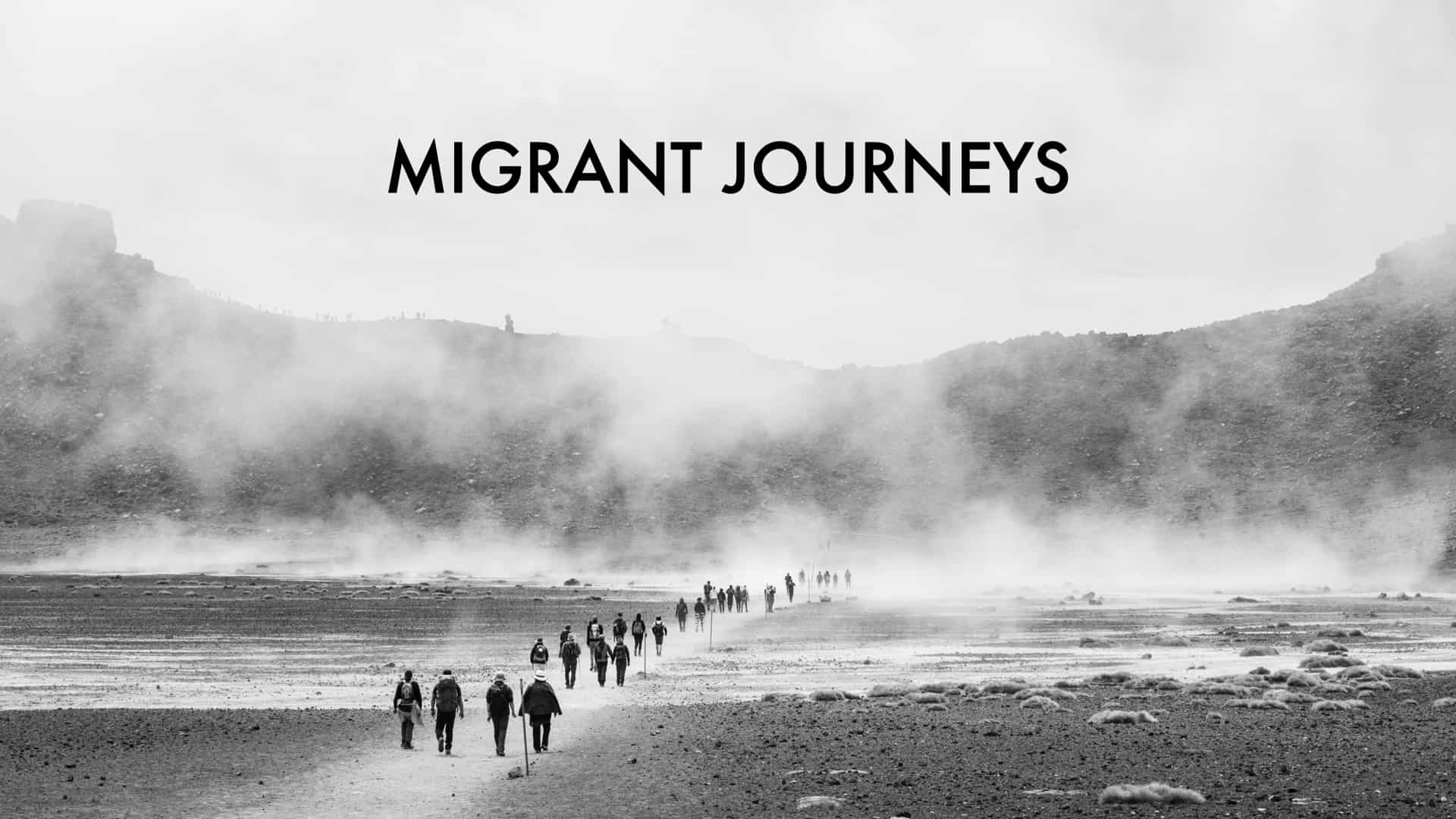
Migrant Journeys: The Syrophoenician Woman
Mark 7:24-30, Matthew 15:21–28
This sermon continues the Migrant Journeys series by examining Jesus’ encounter with the Syrophoenician woman in Mark 7:24–30 and Matthew 15:21–28. Unlike the previous stories in the series, the movement is reversed: Jesus is the one who crosses into Gentile territory, becoming the stranger, while the woman is at home in her own land. Yet despite being on her own soil, she must cross ethnic, religious, political, and gender barriers simply to stand before Jesus and plead for the life of her daughter. The sermon should invite the congregation to see the story through her eyes rather than through the perspective of the disciples. The sermon should resist the temptation to soften or explain away Jesus’ difficult words. Instead, it should linger in the tension of the passage, recognizing the painful reality of exclusion and dehumanization that immigrants, refugees, and marginalized people have experienced throughout history. The Syrophoenician woman refuses to accept the boundaries placed around her dignity. With remarkable courage and wisdom, she answers Jesus’ metaphor with one of her own, and Jesus receives her words, praises her faith, heals her daughter, and demonstrates that the kingdom of God is breaking beyond the boundaries people had assumed were permanent. The sermon should conclude by turning the question toward the church today. Rather than asking only what this woman teaches us about faith, it should ask where we still draw lines that Christ has already erased. Connecting Isaiah’s vision of God’s house for all peoples, Paul’s declaration that Christ has broken down the dividing wall of hostility, and Jesus’ teaching that welcoming the stranger is welcoming Christ himself, the sermon should call the congregation to repentance, hospitality, and courageous love. The final invitation should leave listeners reflecting on a single question: Where have I been drawing a line that Jesus is asking me to let go of, and whose dignity is waiting on the other side of it?
Sermon Notes
We're grateful for you and the gifts of God that you bring with you into this space. As a church, we want to live in God's unfolding story, being transformed by Jesus, learning to belong to each other across our differences, as God invites us into freedom, joy, and boundless generosity.
Whether this is your first time with us this morning or you have been part of our community for a while, we pray you will feel the invitation of the Holy Spirit to join in with our vision. And if you are looking for a church home, we would love to become your church home, and Hannah, Shaun, and I would love to become some of your pastors.
We're in week five of Migrant Journeys, reading Scripture from the road. Today we come to a woman with no name, a mother the text calls only the Syrophoenician woman.
She Was Home, and Jesus Was the Stranger
Hear how each of these migrant journeys has begun. Something happens that makes home impossible, and a person ends up on the road. For Abram and Sarai it was a famine, a force that came from outside the family. For Hagar it was the cruelty inside the household that used her and then drove her into the wilderness. For Joseph it was the jealousy inside his own family that sold him across a border. And last week, Ruth left everything she had ever known and crossed into a foreign land out of love.
But watch what happens today, because the road runs the other direction. This week Jesus is the one who crosses the border. Mark tells us he went away to the region of Tyre and Sidon, Gentile territory, foreign soil, the very cities the prophets had once thundered against. He is the outsider now, and he is trying to stay hidden, because the text says he did not want anyone to know. He wants rest, and he wants quiet.
Into that quiet walks a local woman who is done being quiet. In every other story this season, the people of God have had to decide how they would treat the stranger who arrived among them. Today the question gets turned inside out, because the stranger who arrives is Jesus, and the one who has to fight to be seen as human is a woman standing in her own hometown.
Who She Is, and What She Has to Cross
Let's slow down and actually look at her, because the temptation is to skip straight to the ending and miss who she is. Mark calls her Syrophoenician, a geographic marker, a woman from the Syrian province of Phoenicia. That much is easy to pass over. But watch what Matthew does when he tells the same story, because Matthew calls her a Canaanite.
Sit with that word for a moment. Matthew did not have to reach that far back, because he is writing decades later and he has perfectly good contemporary vocabulary available to him. He chose Canaanite on purpose, and his audience felt it in their bones. The Canaanites were the people Israel displaced, the historical enemy, the ones you were warned in story after story to stay separate from. She is not a foreigner in the general sense. She is that foreigner, the one Israel's memory had already filed under does not belong.
Now look at everything she has to cross just to stand in front of him. There is the ethnic wall, a Gentile woman approaching a Jewish rabbi. There is the religious wall, no covenant and no synagogue and no standing to make a claim on Israel's God. There is the political wall, tensions in that region that were not ancient history but living land disputes and trade fights and generational resentment. And there is the gender wall, a woman approaching a man in public with no male advocate beside her.
Here is the sharpest way to feel those walls. Only two chapters before this, a man named Jairus fell at these same feet and begged for the life of his own daughter. Jairus was a synagogue leader, a Jewish man of standing, and when he fell down no one in the room so much as flinched, because a man like that had every right to ask. This woman does the exact same thing. She falls at the exact same feet and begs for the exact same mercy for her own daughter, and everything about her turns the exact same act into a scandal. Set the two of them side by side and the walls stop being abstract, because now you can see them.
That is four walls, and she walks through all of them. She does not do it because she is clever, and she does not do it because she has rehearsed an argument. She does it because her daughter is sick and she is out of options, and desperation has a way of making borders feel smaller than they are.
The Hard Word, and Why We Will Not Sanitize It
She falls at his feet and begs him to cast the demon out of her daughter, and here is what Jesus says to her: "Let the children be fed first, for it is not right to take the children's bread and throw it to the dogs" (Mark 7:27).
This is where a lot of sermons pump the brakes and rush to reassure us. He was only testing her, we say, or he did not really mean it. I understand the impulse, because we love Jesus and we do not want him to say something that makes us wince. But we are not going to rush past it this morning, because if we sanitize this moment we lose the very thing that makes it holy.
Take that word in. Dogs. In that world it was not a term of endearment, it was the word you used to draw a line and tell the room who was in and who was out. It is the same move we have watched all season long. It is Potiphar's wife hissing "the Hebrew slave." It is Egypt looking at Joseph's people and deciding they were too many and too strong. It is the language of dehumanization, and remember what we said last week about what that language takes. To do that to another human being, you have to break the bond that says you and I both carry the image of God. It does not come naturally, and so you have to work at it.
And in this moment, that language comes out of the mouth of Jesus, aimed at this woman, in front of his disciples. I am not going to smooth that over for you. Honest people have wrestled with this text for centuries, and they land in different places. But whatever else is happening here, she receives a hard word, the same hard word that the immigrant and the refugee and the Black and Brown mother in this room have heard before, that the bread is not for you and your children are not first.
She Rebukes Him, and She Names Her Dignity
And she does not flinch. She does not argue him out of it on a technicality, and she does not grovel. She takes his own image and turns it back on him: "Yes, Lord, yet even the dogs under the table eat the children's crumbs" (Mark 7:28).
Hear what she is doing, because it is astonishing. She will not accept the line he just drew, and she reaches straight past the insult to lay hold of the one thing no one can take from her. She and her child belong to the human family, and the God of this table is generous enough that even the overflow of it is life. This is not groveling and it is not a clever dodge. It is truth-telling with an attitude, and in that moment it is all she has, and it is enough.
And there is something underneath her answer that the men standing there should have caught. Only a few sentences earlier, in this same chapter, Jesus had told them that nothing outside a person can make them unclean, that defilement is never about what you touch or where you come from but about what rises up out of the heart. Now the woman the whole world had labeled unclean from the outside, foreign and female and trailing a demon in her own house, is standing in front of him, and she will not let that teaching stay theoretical. Her words hold him to his own word.
Then comes the part I do not want us to look away from. She is the one person in all four Gospels who wins an argument with Jesus, and Jesus lets her win it. He receives the rebuke, and he does not defend the wall, he takes it down. Matthew remembers him saying, "O woman, great is your faith." But Mark, telling the very same scene, credits something even more startling. Mark says, "For this saying, you may go, the demon has left your daughter" (Mark 7:29). Hear what he credits there. Not only her faith, but her saying, her words, the argument she just made. She reasoned with God, and God told her she was right, and her daughter was healed from that very hour.
The kingdom breaks open in that moment, and notice how it happens. It does not break open because she climbed up and became an insider. It breaks open because she stood her ground as herself and refused to let her dignity be up for debate. The outsider ends up teaching the insider what the table was always for.
Who Do We Call Dogs?
And now the text turns and looks at each of us, because we are the ones holding the power now. We are the ones who get to decide whose children come first, and we are the ones with a table and a border and a whole vocabulary for telling people which side of it they belong on. So we have to ask the honest question. Who do we call dogs? Whose children have we decided are not first, and whose humanity have we quietly turned into a policy debate?
And notice what the fight was actually about underneath, because it was about scarcity. Bread and crumbs and children first, that is the language of a table where somebody has already decided there is not enough to go around. That fear is almost always the thing hiding underneath the wall, the quiet conviction that if we let them in there will be less for us. But the God of this table keeps a different set of books. There is bread for the children and there is bread for the little dogs, there is food for the native and there is food for the foreigner, there is plenty for you and there is plenty for me. We called it boundless generosity a few minutes ago, and this is what we meant.
I am not reading this from the newspaper, I am reading it from the good book, but you already know how modern it sounds. Too many. Too strong. They might side with our enemies. We say we follow the Jesus who ended up on Gentile soil healing a Canaanite woman's daughter, and then we build the very walls she had to walk through. We fondly tell the story of our own family's crossing, and a generation later we turn and call the next family at the border a danger.
So hear the gospel as it rebukes us. To welcome the stranger is to welcome Christ himself, because Jesus said it plainly, that "I was hungry, I was a stranger, I was in prison, and whatever you did for the least of these, you did for me" (Matthew 25). The writer of Hebrews tells us that some have welcomed angels without ever knowing it (Hebrews 13:2). And here is the deepest word of all, that the image of God is not something anyone earns at a checkpoint, and God's gaze does not require documentation.
Isaiah saw it centuries before that road to Tyre, when God said "my house shall be called a house of prayer for all peoples" (Isaiah 56:7). All peoples, not some peoples once they have proven themselves. And Paul, on the far side of the cross, names what it cost, that Christ "has broken down in his flesh the dividing wall of hostility" (Ephesians 2:14). Broken down, not adjusted and not relocated, but broken down.
A Word Before We Pray
I want to be honest about one thing before we finish, because this story could tempt us toward too tidy an ending. This woman spoke up and she won, and she won because the one she was arguing with was just and good and could be moved. But not every mother who speaks up meets a hearer like that. Some of them tell their story to a system that decided long ago not to hear it, and they lose, and they are punished for the trouble of asking. So we have to say why we speak up at all. We speak up because raising our voice for our own dignity, and for the dignity of the person beside us, is not finally about whether we win. It is about refusing to let the wall have the last word in us, and it is the very thing this woman puts on display.
So here is what I want us to carry out of this room. That woman leaned into a wall she had every reason to believe would hold, and it did not hold, because it was already coming down. She reminded even Jesus of the dignity that she and her daughter already carried, and the table, it turns out, was always wide enough for them.
I want to leave you with one question to sit with this week, and it is a hard one. Where have I been drawing a line that Jesus is asking me to let go of, and whose dignity is on the other side of it?
Let us pray.
God who crossed the border to sit with us, God who heard this woman when the room wanted her gone, God who honored her when she would not let go of her dignity or her child's, we come to you honestly this morning. You are the God who sees the outsider, and you have never once looked away.
We confess that we have built the very walls you came to tear down, and we have called your image-bearers by names you never gave them. Forgive us, and give us her stubbornness for the dignity of the stranger. Give us eyes that see a Ruth, a Hagar, a Joseph, and Christ himself in the face of the one we were tempted to turn away.
Make of us a house of prayer for all peoples. We pray in the name of Jesus, who entered our suffering and redeemed it, so that we might come alive. Amen.